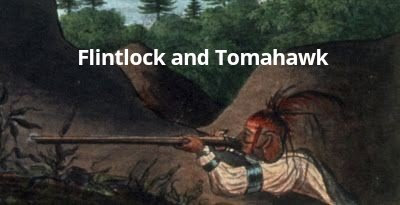
This document was posted by Rebecca Jordan of the Woodland Confederacy on http://groups.yahoo.com/group/NativeList/
it concerns a European perspective on the Native allies that fought for Britain in the American Revolution
LETTER OF A BRUNSWICK OFFICER (excerpt)
in the army of General Bourgoyne, to a friend in Brunswick, Fort St. Anne, March 1777 translated by Geert van Uythoven...
The way battle is waged over here is very special, and differs totally from our systems. We campaign only two men high, and one man has to act on a distance of 18 Zoll from the other, to be able to march in line inside woodsand bushes. Cavalry is totally useless, and therefore our dragoons have to depend on their legs. Our colours encumber us much, and none of the English regiments has brought theirs with them. Every English regiment has a separate grenadier-, and a light company, which are formed into combined battalions which are of great use. The Corps Canadian Volunteers is not to despise.
The savages cannot be trusted because of their innate bestiality.They are very brave, but also very unbridled, and therefore have to be accompanied by English or Canadian officers. Above all they wish to fight independently, not under the command of English generals or officers, as true allies and friends of the king. One certain Iroquois, called Joseph, has been in England for some time. He knows to make a correct judgement of the interests of the English and savages, and he tries to build himself a name as chief of an army of savages. One is trying to prevent this in every possible way, then God should be merciful to the colonists that will be their neighbours. The savages are queer birds [sic!], which fall from one extreme into the other easily. I have been in Loretto, an old settlement of Huron's, which over eighty years ago were converted to Christianity. They have qualified themselves for regular cultivation and cattle-breeding. However, with surprise one notices that they cling to their old habits with perseverance. Their church is curious, and without any chairs or pews; on the other hand it is filled with handmade wooden saints, which, although they were Hebrew,Roman, Greek, or from another European nationality, are now depicted assavages in savage clothes and painted in many beautiful ways. I will noteasily forget the good Petrus, with his keys and beautifully painted face. I could tell you grotesque stories about their monarch Athanas who resides here, and who is honoured by the savages for hundreds of miles around. Aswell as about the prince, their upper-steward, and his three daughterprincesses. However, for now the hour-glass has been completely run through.(…)"
The expedition which has been mentioned, departed by water on the 16th. The author of the above letters has kept a diary of it, of which we will print the part which describes his first meeting with the savages:"On 21 June General Bourgoyne, Major-General von Riedesel, and bothBrigadiers Specht and von Gall departed for the camp of Brigadier Fraser at Rivière Bonguet, five hours distance from our camp. Here we saw a congress of savages of three tongues, which offered their services to GeneralBourgoyne. For the audience, a huge summer-house was build. Such a ceremony is very extraordinary, and I will describe it in detail some time when I have more time to spare. The deputies sat all in a circle on the naked ground, and smoked in their Calumots such a terrible tobacco, that one couldsuffocate. Their faces are painted with black and red, according to anyone's fantasies and ideas. The mutilation of their ears in many different ways is very special. Many have cut lose the complete edge of their ears, which hangs down like some decoration. The decoration of their hair is even more striking, and rarely one sees one of which not all hair has been pulled out except of a small part at the back of their heads, the bald places which have been created this way been painted with various figures. In their nosethey wear rings with small bells, or they pierce them with big red feathers or even blades of grass, etc. I especially liked one certain individual; he had painted one half of his face black, the other half red, and on the black half he had painted a red, on the other red half a black moustache. General Bourgoyne accepted the offer of the savages of Sault St. Luis or Kaynuawaga, of Jamaska and of the Abenaki's, and assured them of his friendships and reward. At the same time he pointed out to them, that all savage nations of the American continent had been summoned to serve against the rebels. In addition, they were urged strongly to spare old men, women and children, and not to scalp prisoners nor wounded. After that, they were regaled with some fat oxes and several casks of rum."
Source: Militair-Wochenblatt, 18. Jahrgang (Berlin 1833), No. 865, pp.4862-4860.(c) Geert van Uythoven


